Research by Shouxia Wang et al. on Dynamic Synthetic Control for Semiparametric Time-varying Models Accepted by SCIENCE CHINA Mathematics
Research by Shouxia Wang et al. on Dynamic Synthetic Control for Semiparametric Time-varying Models Accepted by SCIENCE CHINA Mathematics
Recently, the manuscript “Dynamic Synthetic Control Method for Semiparametric Time-varying Models” by Shouxia Wang, Xiangyu Zheng and Song Xi Chen has been accepted for publication in SCIENCE CHINA Mathematics. The study develops a dynamic synthetic control method accommodating nonlinear relationships that vary over time. It applies the method to evaluate emission-reduction measures during air pollution alerts in Beijing.
Changes in an observed outcome after a policy intervention may reflect both the policy and other influences. Air pollution concentrations, for example, depend on emissions, meteorological conditions such as wind speed and humidity, and previous pollution levels. Some meteorological factors have pronounced nonlinear effects on air pollution concentrations. In many settings, randomized controlled trials are difficult to conduct, so policy evaluation often relies on observational data. The key is to estimate how outcomes in the treated group would have evolved without the intervention. Synthetic control methods estimate these counterfactual outcomes by taking weighted averages of observed outcomes from untreated units. The team’s earlier work on linear dynamic synthetic control allows these weights to change over time. Building on that work, this study accommodates nonlinear effects of covariates and lagged outcomes, while allowing these relationships to evolve over time. This flexibility improves the model’s ability to accommodate complex dynamic data.
The paper uses a semiparametric time-varying additive autoregression model to describe the outcome. It models the time trend, covariate effects and lagged-outcome effect separately. Unknown functions are estimated using a spline-back-fitted-kernel method. Empirical likelihood then constructs time-varying synthetic control weights that match the estimated function components. The framework accommodates multiple treated units and considers spatial correlations between units in its theoretical analysis. The paper distinguishes between linear and nonlinear effects of the lagged outcome and develops corresponding recursive constructions of counterfactual outcomes. A linear effect allows computation based on group averages, whereas a nonlinear effect requires consideration of individual counterfactual dynamics. Under appropriate regularity conditions, the paper studies the theoretical properties of nonparametric function estimates, empirical likelihood weights and estimated average treatment effects on the treated. It also develops a test for linearity in the lagged outcome, a pre-treatment diagnostic for the unconfoundedness assumption, and a normalized placebo test for assessing treatment-effect significance.
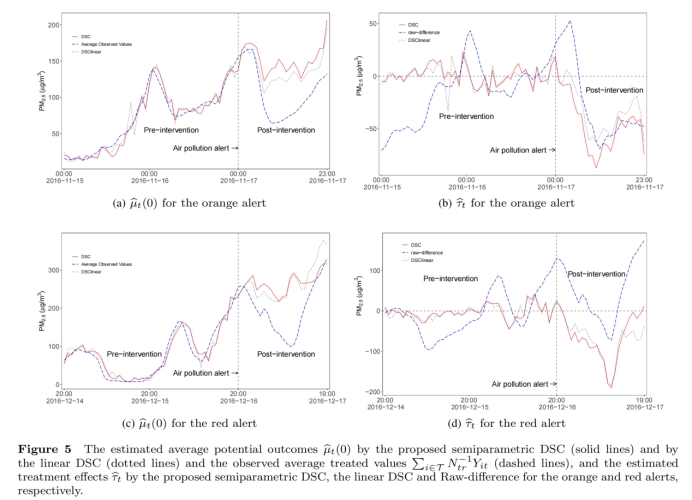
Simulation studies examine finite-sample performance, followed by an evaluation of emission-reduction effects during two air pollution alerts in Beijing. The analysis covers the 24 hours following an orange alert on November 17, 2016, and a red alert on December 26, 2016. The study identifies pronounced nonlinear effects of meteorological variables, including wind speed, humidity and dew point temperature, on PM₂.₅ concentrations. These findings highlight the importance of flexibly modeling such relationships in policy evaluation. The study extends dynamic synthetic control to semiparametric time-varying autoregression models, providing a statistical tool for policy evaluation with nonlinear confounding and dynamic dependence.
Shouxia Wang, the first author, is an Assistant professor at the School of Statistics and Data Science, Shanghai University of Finance and Economics. The co-authors include Xiangyu Zheng and Professor Song Xi Chen from the Department of Statistics and Data Science at Tsinghua University. Professor Chen, who was Wang’s postdoctoral supervisor, is the corresponding author. Part of the research was conducted when Wang was a postdoctoral fellow at Peking University. The work was supported by the National Natural Science Foundation of China (72501165, 12292983 and 92358303). Additional support came from the Fundamental and Interdisciplinary Disciplines Breakthrough Plan of the Ministry of Education of China (JYB2025XDXM801) and the China Postdoctoral Science Foundation (2023M730090). The research also received technical support from the National Large Scientific and Technological Infrastructure “Earth System Numerical Simulation Facility” (https://cstr.cn/31134.02.EL).